Saturday, 20 August 2016

Meaning of life

Why blogging? Why now? Some may ask – well, forget the asking part, I still want to give you the answer damn it! The second question has a straightforward answer – my mind is wandering and letting my steam out through blogging. And what better way of achieving that high purpose in life than to immerse this whole wide world in the sea of my thoughts? “Yaam petra inbam peruga ivvaiyagam” - Let this world bequeath the pearls of my wisdom.

Come to think of it, what is the purpose of life?! Isn’t the purpose to live that very life? Which in its most trivial form is to kill time? Are we not living for the sake of living, till death takes us away. Wow, I guess I have inadvertently stumbled upon perhaps the greatest revelation in life that people have been searching for all over the place for ages together!

‘The calling from the inside’ – is what I would like to call the subject matters or rather the content of these blogs. Over the years, this calling has gone unanswered. I remember those numerous occasions when I wanted to vent out the steam from the conference room or those lobbies lined with cubicles. Those moments when I was at the receiving end of those endless words of advice. I kept hoping that I will get answers, but I remain confused, inspite of talking to many. Some find it silly and some believe these are wasteful thoughts. What about those life changing ideas that my brain dares to conceive? Or just those colorful pastures of my dream land? Where do I paint them all? Right here in my blogs!! For those who want more variety, don’t you worry, you will get them all, if not already through my previous blogs.


As I sit, believing that I have it in me to be the next big thing in the writing world, I realize its about time I dove in. I do have a penchant for writing you see, which may or may not be much appreciated in this morbid world. But that’s beside the point. After all, it’s my birth right to express my thoughts on anything and everything. And being born in the world’s largest socialist republic, it would be injustice if I don’t give form to that very right. So world, I remain what I am and will write whatever random thoughts that occupy my mind. For now, I can live with your hats, the brick bats be saved!

Friday, 18 March 2016

Who really killed Kingfisher Airlines & made Vijay Mallya a 'willful' defaulter?

A big article on who killed Kingfisher Airlines and made Vijay Mallya the fallen guy. This was sourced from Internet. But could not disagree on the content. Hence, reproducing same.

Everybody, even most of my learned friends want Vijay Mallya arrested. They say he had fun at the cost of Public Money, he should be punished. They say he is a fraud, he lives a rich and luxurious life, while not paying salaries to his staff and not paying his lenders and vendors.

Who killed Kingfisher Airlines? Have you given a thought? As a citizen of India you should know. As an entrepreneur you should definitely know this. I am sharing below a sequence of media reports from the days of the fall of KingFisher Airlines began. I hope to construct the sequence right, so that you can understand how it was killed. and by whom.. A little, backdrop would be, if you recall, or perhaps can google to verify my statement, Most Airlines across the world were doing bad those days. Many were in the verge of collapse.


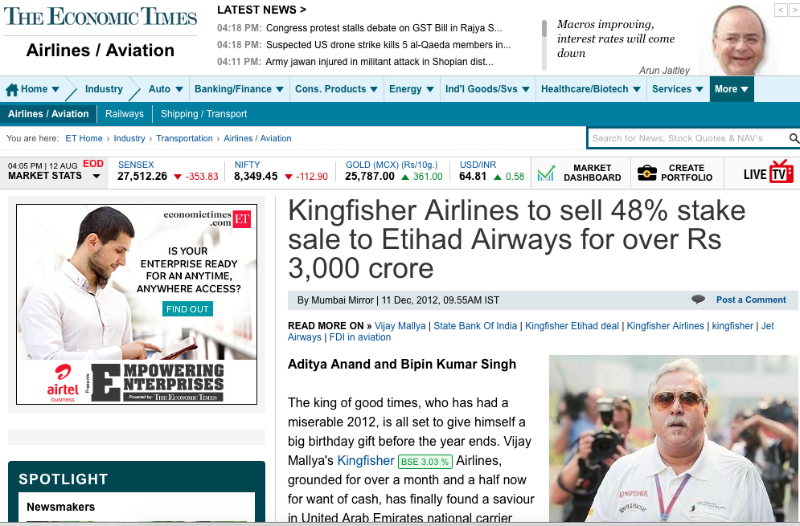
 economictimes
You may note Jet Airways stocks had plunged around the same time in Jan 2012.

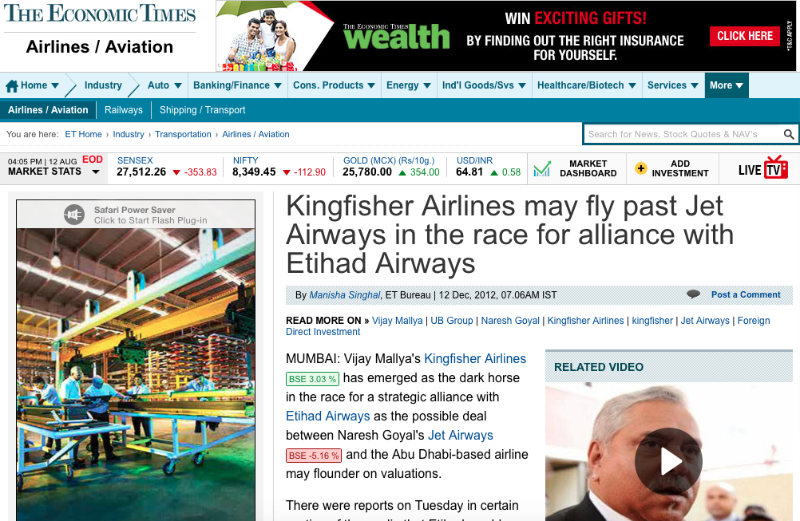
You may notice, Kingfisher was doing better than Jet Airways.

Kingfisher desperately had to infuse funds and this was the best thing Vijay Mallya and his team could have done.

It was very well placed. But what went wrong?

It appeared to be a done deal, what went wrong?

Not just me, everybody seem to think / say so... then.

It was obviously not similar thoughts towards Jet Airways.. then.. what went wrong?

Same SBI had hopes on Kingfisher Airlines.. then..

This is the beginning..

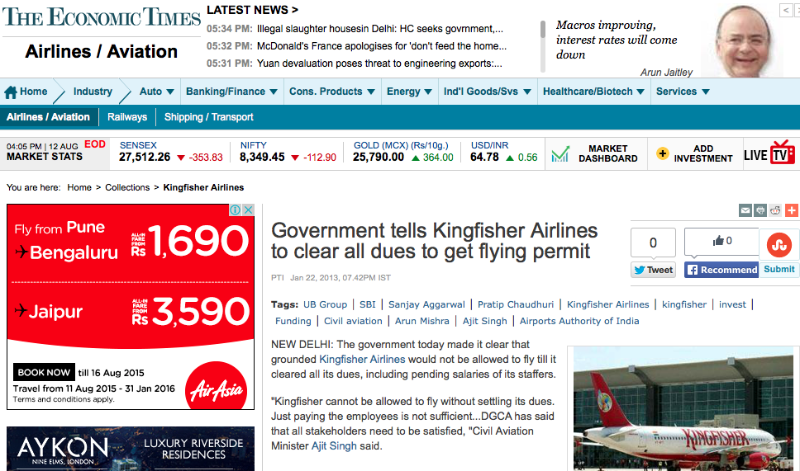
Government agency thinks contrary to Market and Banks... why?

Kingfisher Airlines team does, what any serious enterprise does..

Why is Kingfisher targeted, while all Indian Airlines were in similar situation then?


Why stop an Airlines from flying?
How will an enterprise pay salaries, when agency meant to support the player is keeping it away from raising funds..

Does this help you understand better, what happened?

Its important to understand the share holder details of Jet, particularly, foreign and Indian Share holders.
Note the percentage of General Public & Foreign promoters as share holders in Kingfisher.

Note the general public in Jet Airways and also foreign promoters.


Etihad was still interested in Kingfisher and not Jet Airways..

Kingfisher tried things Legally, but what was at play??

Why every possible government machinery tried to scuttle Kingfisher Airlines?

Is this the final nail..??

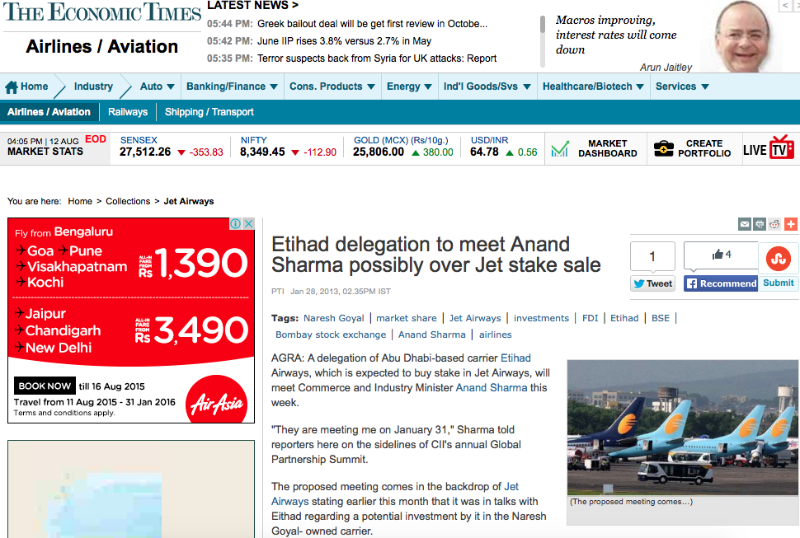
Etihad comes around and agrees to go with Jet Airways. Anand Sharma was the Commerce Minister.

Then met Finance Minister.. Why, all this to help a company held by majority of foreign promoters?

Why was Indian Government stretching to do this for Jet Airways, while Squeezing Kingfisher Airlines?

This was perhaps the last nail but we know, what else is happening with the (Once) King of Good times..
Who killed Kingfisher Airlines? Who got Vijay Malaya to this state? Who were the beneficiaries? Can an Indian Entrepreneur dare to do things in his own Country again? Will Indian government support her/him, or lead to what happened to Kingfisher Airlines and Vijay Mallya?

I have never had Kingfisher Airlines or any of Vijay Mallya's company shares. I have neither been his Associate nor employee. I am writing this to share with my learned friends, this is the truth I saw. I feel bad for Kingfisher Airlines and Vijay Mallya as an entrepreneur. I don't want such a thing to happen to any entrepreneur.


Thursday, 25 February 2016

Advice to finance professionals

1.    Be child-like in your curiosity. As Rudyard Kipling said,
"I keep six honest serving-men
They taught me all I know
Their names are What and Why and When
And How and Where and Who..."

2.    Give a premium to learning and learning opportunities. Seek the roles that give you the maximum learning opportunity - especially early in your career.

3.    Deliver on commitments - keep the "What you do" to "what you say" ratio high. It adds credibility and builds up your personal brand.

4.    Embrace technology - technology is a friend that expands our capabilities. Embrace the technogical advancements and increase your productivity.

5.    Ethical values - Finance professionals are expected to be conscience-keepers; always act with Integrity.

6.    It is good to be individually brilliant, but unless you are able to work in a team and harness each other's core competencies, you will always perform below par.

In this fast paced world, learnability (ability to learn things quickly) and the ability to collaborate in teams will definite success in careers and in long life.

Thursday, 4 February 2016

Anupam Kher – why are you complaining?

Pakistan and India routinely deny visas to people of either countries - both prominent and otherwise - and often it doesn’t make news. Indians who visit the Pakistan embassy in Delhi know how hard it’s to get hold of a visa and how hard it’s to deal with the immigration and police officials once you reach Pakistan.

Pakistanis, including those raised in the West, too have similar stories with some even vowing never to return again - it’s about reciprocity and that’s exactly how countries behave, whether they are friendly or not. India and Pakistan are not friends.

So we regularly deny visas to hordes of cross-border pilgrims and a lot of popular Pakistani artistes on both security and procedural grounds, and Pakistan too does the same from time-to-time. There’s no question of who started it first because it has been going on for ever. And that’s how foreign affairs work.

Some times, these security and procedural concerns are real, and some times political. Remember, when America introduced finger printing of overseas visitors, Brazil retaliated instantly by asking American tourists on Brazilian ports to queue up for a reciprocal procedure - they didn’t even have an electronic finger-printing machine and had to do with a finger-pad and paper.

So, what’s the big deal Anupam Kher?

You are one of the many Indians who happened to be on Pakistan’s radar now for reciprocal action. And just because you think you have some endowment owing to your proximity to the BJP, you feel outraged. Of course, they are making a point by singling you out. And that’s exactly how it works.

This is not the first time; and this will not be the last time either. And, it’s also not because you are with the BJP. In the past, Bollywood’s favourite poet Javed Akhtar was singled out from a group that was to visit Pakistan to raise money for 2005-earthquake victims during the Congress-led UPA rule.

He had no sympathy for saffron politics and was a strong advocate for religious tolerance - traits that Pakistan could have exploited in their favour. On another occasion, actor Feroz Khan was thrown out of the country because of his allegedly drunken anti-Pakistan tirades on Pakistan-TV.

India too had denied visas to a lot of prominent Pakistanis - mostly good looking actors and talented entertainers who had a following in India - Imran Abbas, who acted with Bipasha Basu; Humaima Malick, Emran Hashmi’s pair in one of his movies; Mahira Khan, Shah Rukh Khan’s reported pair in Raees; and may others including singers Arif Lohar, Javed Bashir, Imran Aziz Mian and Sahir Ali Bagga.

And most recently, Rahat Fateh Ali Khan was deported from Hyderabad airport, immediately on arrival, on technical grounds - apparently Pakistanis can enter India only through the ports in the four metros. Even more bizarre bar on entry was on Ghazal king Ghulam Ali, on whom the government had no problem, but its alliance partners had. So a harrowed and amused Ali could sing only in West Bengal and Kerala, but not anywhere else. And did this not led to him vowing never to perform in India in the future?

Pakistanis too do the same thing. They deny visas to ordinary citizens and more prominent ones at will, and they do harass and restrict movement once Indians land on their soil. For instance, if you have a visa only for Islamabad, you will be chaperoned to a detention area for your connecting flight if you transit through Lahore.

So, why is Anupam Kher complaining?

Because he wants to make a bigger national hero out of himself - a man hounded by Pakistan because he is against Muslim terror in Kashmir, because he is a displaced Kashmiri Pandit and because he is a strong nationalist. And during the present times of hyper-jingoism, a lot of people will stand by him and bash others with alternative-opinions, including those who bat for track-two diplomacy and cricketing ties, and those who criticise human excesses in Kashmir.

One cannot blame Kher's perpetual peeve of forceful displacement that many Kashmiri Pandits all over the world feel, but using it for political aggrandisement is not cool. When Javed Akhtar was singled out, he didn't care; neither did Feroz Khan.

Every time a BJP-led government comes to power, it’s windfall time for people such as Anupam Kher because there aren’t too many A-listers in Bollywood who show open allegiance to partisan political ideologies. Most of the art-house film-makers are habitually Left and secular and hence openly oppose the BJP and its interventions in art, while the others keep a safe distance. It’s only people such as Kher, Gajendra Chauhan, Pahlaj Nihalani and Hema Malini who stick their neck out.

Obviously they do get rewarded. In the recent uproar over intolerance, while almost all the elites of the entertainment industry and the art-house crowd covertly and overtly criticised the Modi government, his party and proxies for their alleged intolerance, it was Kher who managed to parade a group in support, although comprising comparatively insignificant names. Coincidentally, he got a Padma Bhushan. Last time, more than ten years ago, his reward came in the form of a Padma Sri. The Padma Bhushan probably took longer because of the UPA- interregnum.

There’s no denying the fact that the actor is a household name for his prodigious volume of work in Bollywood, and some unforgettable performances; but it’s his pro-BJP politics that gets him the bigger stage and even bigger political profile. The Pakistan visa denial is just another opportunity to play up this political card and Hindu-nationalism.


Let him do that because he benefits from it, but the rest of the country should take it easy. There’s nothing new. India has detailed and even deported people of other nationalities for silly reasons. Denial of visas, selective scrutiny and bad behaviour at immigration counters because of the colour of your skin, language and passport, and restriction on your movements are the reality of the world. And India-Pakistan friendship is just a myth that we will continue to play for another 1000 years.

Saturday, 19 December 2015

Delhi proposal for pollution control –absurd or brilliant?

To begin with, the sources of pollution in the capital aren’t clear: factories, crop burning in neighbouring states, power plants, cooking on coal or wood stoves, old autos and aged commercial vehicles are also significant polluters. Incidentally, none of those in the last category will be covered in the odd-even plan proposed by Delhi government. Without a clear calculation of how much private vehicles contribute to Delhi’s pollution, making half of them sit idle at all times seems like a draconian and ill-conceived idea.

Next, we just don’t have the traffic police manpower to track adherence. Theoretically, scheme supporters may believe that people will be good. However, if we were good people, all of India’s schemes would have worked. There will be legal ways around the scheme (buy another car for the number plate, often an old, second hand, more polluting one) or illegal ways (fake an emergency certificate, bribe the cop, take a chance, switch the number plate). After the initial euphoria and media frenzy around the scheme dies, Delhiites will figure out a way to get their cars on the road.

For those who adhere to the rules, they will end burdening the already choked public transport system even more. Autos will either not be available, or will overcharge. Metros, already packed, will become worse. Delhi doesn’t have public transport like Paris and Singapore (where such measures were applied, albeit only on a temporary basis). Alongside this, there will be tremendous negative side-effects for certain sections of our society. Many drivers will be without jobs, goods won’t move efficiently causing inflation and school kids who travel in private vehicles will suffer.

The worst part is this quick fix solution will give us a false sense of achievement while the real solutions will be ignored. In many places where such measures were tried, such as Mexico and Bogota, they have failed. In Beijing, an often touted example, the measure worked somewhat but it was temporary, for a specific event. Also, Beijing is not a democracy, and the plan fits into what an authoritarian state would do. In democratic India, we must think a hundred times before we steal our people’s freedom. Incidentally, Beijing also rolled tanks on people who tried the kind of movements from which AAP was born. Hence, compare cities with caution.

Solutions do exist. The long-term solution is to create more world-class cities like Delhi, so we reduce the pressure from the super metros. The super metros also need a much better public transport system. Provide metros & public transport that people would prefer of their own, as in places like Finland & UK, where there are excellent public transportation. In India, if a middle class or well to do person says that he took public transport to office, he is often looked down or considered to have class. This is largely due to the facilities & comfort provided in these public transportation.

Statistics say that vehicles are not the only polluters and in fact, contribute to less than 1/3rd of the pollutants. That being the case, reducing vehicles alone will not help and there can be adverse effect, through loss of productivity, increase in intolerance (favourite buzzword around currently) etc.

In the short term, we can incentivize offices with lower taxes to have different work hours, which will balance out the traffic and make it move faster. A car stuck in a traffic jam pollutes much more than a car that quickly finishes its journey. We can also raise taxes on purchase of new cars (or limit their numbers). We also need Radio Frequency Identification Device (RFID) tags on all cars in the city, so we can introduce peak hour congestion charges and other such road optimization measures. Many cities across countries (London, Singapore, Stockholm, Milan etc.) have introduced congestion pricing or charges & have seen improvement in congestion during peak hours in urban areas. Taxi sharing apps must be encouraged for they can go a long way in reducing cars on the roads.

The issue is not limited only to Delhi, every metro city in India is struggling with pollution. Just that, Delhi’s situation is out of control, for the pollution is at its excess during winter. While other cities/government has done lip service to curb pollution, Delhi government is willing to bite the bullet and implement anti-pollution measures, although had to water down the proposal to exclude only ladies driven car, rule only between 8 AM to 8 PM, exempting two wheelers, Sundays exempted, initially only between Jan1 to Jan15 etc.


Make no mistake, AAP deserves credit for trying to do something about Delhi’s pollution. Delhi deserves better air but it also deserves more sensible solutions to achieve the same.

Wednesday, 14 October 2015

Read situations in all the perspectives

The sage Narada wanted to marry a young princess. But she said she wanted to marry only Hari. Hari is the name of Vishnu, who is God and the guardian of earth. Narada went to the princess but instead of garlanding him, she turned around in disgust. There behind her stood Vishnu. The overjoyed princess garlanded Vishnu. Narada wondered what was wrong. Then he saw his face reflected on a mirror.

It was that of a monkey! He accused Vishnu of cheating him. Vishnu smiled and replied, “I gave you the face of Hari, which literally means monkey, though it happens to be my name.”

Narada can read the situation in two ways: a strategic narrative or a sincere narrative.
In a strategic narrative, Narada can see behaving like a lawyer, playing with words to make him feel like a fool.
In a sincere narrative, Narada can see Vishnu behave like God, using a play of words to enlighten him not to trick a young girl simply because he can.

In a strategic narrative, Vishnu is the wily trickster who wants for princess for himself.
In a sincere narrative, Vishnu stops Narada from being a trickster and grants the princess her wish.

In a strategic narrative, Narada feels like a fool.
In a sincere narrative, Narada is enlightened.

Every situation can be read strategically or sincerely.
When we read a situation strategically, we feel manipulated; we feel we have been reduced to a performing monkey.
When we read a situation sincerely, we learn from it; we feel someone cares for us enough to demonstrate to us our shortcomings rather than simply pointing it out.

Now to demonstrate this with a practical example:
After completing his course in Australia, Jason returned to India with plans to start a fast food joint. His father, Paul was a renowned restaurateur, with many small boutique hotels in India, saw the business plan and knew that it would not work. But he gave his son the seeding capital he needed for the business.

The hotel started with much fanfare, but was in the red in less than six months. Jason approached his dad Paul and he in turn, sent his team to help out Jason. They made two key changes, in the menu and in the advertising. And in no time, the sample place, which was empty for six months, was now full of customers.

Now Jason has two options, just like Narada. He can read his father’s actions strategically or sincerely. He can see his dad Paul as a manipulator, a dominant father, one who does not want to help him and want to put him in his place.
Or he can see Paul as a teacher, a caring father, who wanted to show him what actually works in the restaurant business.


Jason can feel like Hari, the monkey, or thank Hari, the teacher. The choice is very his…